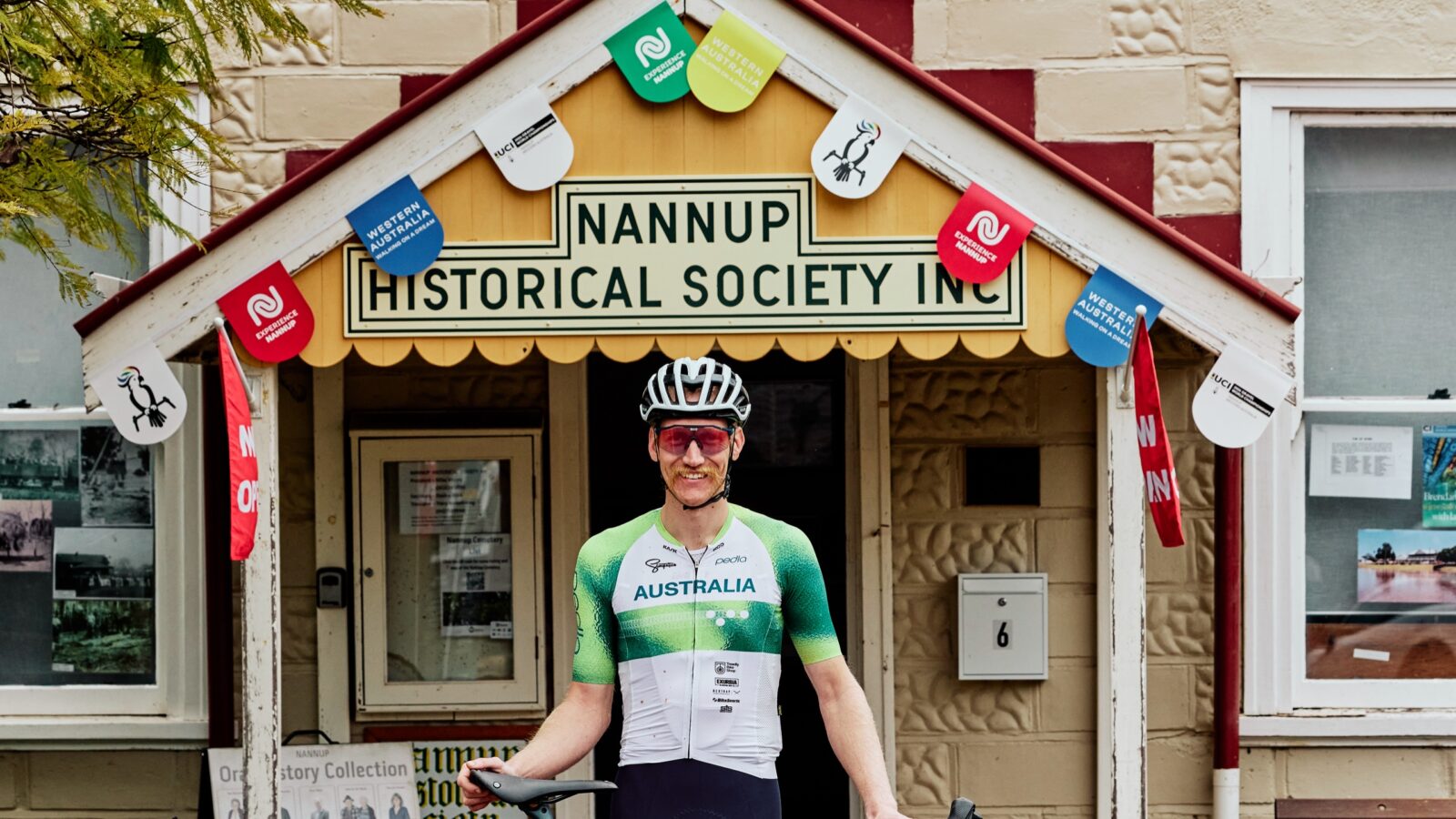
Aidan Lampe expected the 2026 UCI Gravel World Championships in Nannup to be hard. He is an ultra-distance racer, used to riding for days, and a 145-kilometer race at world championship pace asks for something different.
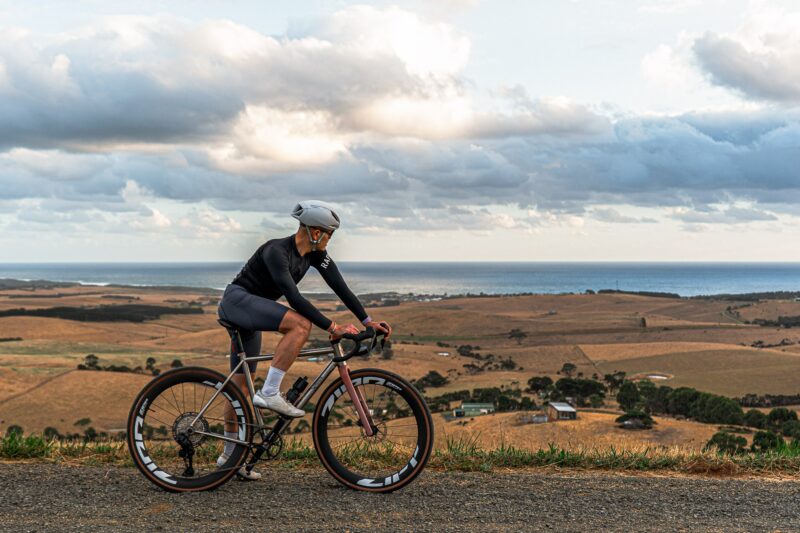
What he didn’t expect was to spend the week before it sick. A heavy cough kept him off the bike for most of that week, so he never scouted the course. His only look at it came on the Friday, when he rode the final 20-kilometer loop, and that was when we photographed him. Within a couple of hours of the shoot, he was vomiting. For the 24 hours before the start, he couldn’t keep food or water down.
“The timing was lucky,” he says of the shoot. The timing of everything else was not. “My body was just basically running on empty on the day.”

An engine built for days, not hours
Over the past few years Aidan has built his cycling around solo ultra-distance events. He has done Race to the Rock three times, a self-supported race from Australian cities to Uluru that ranges from about 2,500 to 3,800 kilometers depending on the edition. In 2024 he finished sixth at the Tour Divide, covering roughly 4,500 kilometers of mountain terrain in fifteen and a half days. Earlier this year, after two years of attempts, he set a 24-hour world record on a recumbent trike: 1,512 kilometers.
Explainer: Race to the Rock and the Tour Divide
Both are self-supported ultra-distance races. Riders carry their own gear, buy food and water along the way, and can’t accept outside help. The clock never stops, so every hour spent sleeping counts against them.
The Tour Divide follows the Great Divide Mountain Bike Route down the Rocky Mountains, from Banff in Canada to the Mexican border in New Mexico. Race to the Rock crosses the Australian outback to Uluru, starting from a different city depending on the edition.
“Some people might consider a 145k gravel race a long race,” he says. “Compared to my specialty, that’s a little bit of a sprint for me.”
The bigger change is the company. “On the ultras, you’re solo. You’re not even following a wheel at all, nothing,” he says. “You can pace it however the hell you want.” A world championship means a bunch, tactics, and going at the pace of the riders around you. He enjoys that, and finds it motivating just to hang onto the wheel in front.
Healthy, his goal was the top 50, the top half of his field. Looking at where the friends he stayed with finished, he thinks he would have made it, even without training specifically for four to six hours of high intensity. “The base I had would have still been sufficient.”
The week before
Coming off an ultra, he knew his body wouldn’t be at its sharpest for high-intensity racing. He was counting on the length of the race, hoping he could hold on and come good in the back half. Getting sick was the nail in the coffin. By race day he had barely ridden, and most of the course would be new to him. “I was unsure I was even able to stand up at the start line, basically.”
By the night before, he was feeling all right, so he made a plan. “I’ll just get on the start line. I’ll start. If I make it to the first feed zone and I’m cooked, I’ll pull out.” A home world championship might not come around again in his lifetime.
“This is potentially the one and only opportunity I’ll ever have to line up in the Australian colours and represent the country,” he says. “I would have been kicking myself if I couldn’t do that.”
Timber country: Nannup, Western Australia

Nannup is a small timber town on the Blackwood River, in the South West of Western Australia, about three hours’ drive south of Perth. The river winds through a valley of farmland and orchards, and the hills around it are covered in jarrah and marri forest and pine plantations, cut through by old logging tracks and fire roads. The race went out into that country.
Much of the gravel there is laterite, small round pellets of ironstone that locals call pea gravel. On a dry day it behaves like ball bearings under a tire. “There was a lot of talk about people’s tire choices and the pea gravel and the slipperiness of it out there,” Aidan says.
It was his first trip to Western Australia. Some of it reminded him of home in South Australia, the kind of place where you think, “this looks just like so-and-so.” Visitors were staying in towns 40 minutes away, and even there you could tell how many people had come for the race. Nannup itself was set up for it. Across the two days, 10 and 11 October, more than 900 riders raced. It was also the first time the UCI Gravel World Championships had been held outside Europe.
“I don’t know if you’d quite get something like that without it being a world championship event,” he says. “Would definitely recommend, if somebody does get the chance.”
Two good hours
Explainer: How amateurs race a world championship
Alongside the elite races, the UCI Gravel World Championships hold amateur races split into age categories. Riders earn a place by finishing in the top quarter of their age group at a qualifying event in the UCI Gravel World Series. Aidan raced in the men’s 19–34 category, the youngest of the amateur groups.
The race opened with about nine kilometers of road in a bunch of around a hundred riders. Aidan sat near the back, on the wheels, with a couple of mates nearby, getting towed out and expecting nothing. “I really had zero expectations on myself because of the lead-in to it. So it was just push as much as I could to get as far as I could.”
To his surprise, it worked. He had been coughing heavily all week, but he was breathing relatively well on the first climb. Over the first couple of climbs he followed the wheels and found himself in the second group on the road, sitting around 50th, right where he had hoped to be when he was healthy. “It was definitely tough, but the legs had it in at that point.”
Then came the first feed zone, and the crowd.

“It was my first time really riding inside two walls of people yelling and screaming as the whole bunch went up there,” he says. The organizers had built a fan zone around it. “The whole Tour de France kind of feeling, through an archway of people as they’re stepping out, hanging over the fence. That first big crowd, that’s an experience and a half.”
For two hours, the plan held. After the second feed zone, it didn’t. On the next climb, with close to 1,000 meters of climbing already done, the group rode away from him.
“I was just at the limit. Body couldn’t push any harder, and I was just like, ‘All right, well, I guess that’s me done there.'”
From that point, the race was about finishing. “Just there for the vibes after that, really.”
The worst bonk of his life
Aidan has been deep into fatigue many times. Ten days into an ultra, he has known sleep deprivation and sore, worn-out muscles. This was something else.
“That was probably the biggest wall I’ve ever hit,” he says. “If you’ve hit a hunger flat and you’re bonked, this is what I would say would be the worst I’ve ever had in my cycling experience.”
Explainer: What is a bonk?
A bonk, which Australians also call a hunger flat, is what happens when the body runs out of stored carbohydrate. The muscles and liver hold a limited supply, called glycogen, enough for roughly 90 minutes to two hours of hard effort. When it runs out, the body can’t hold the pace, however fit the rider is. The legs go heavy and the speed falls away.
Riders hold it off by eating carbohydrate on the bike and by eating well in the days before a race. Aidan kept drinking his bottles until his stomach gave out, but he had started with almost nothing in the tank.
The ultras never felt like this. “I’ve had real bad sleep deprivation and body fatigue from that, but it’s a different kind of experience,” he says. “Muscles have been fatigued and sore from riding for 10-plus days, but it’s not the same emptiness.”
He doesn’t think his fueling on the day was the problem. He kept getting bottles down until around the four-hour mark, when his stomach stopped accepting them. The problem was what he started with, which was nearly nothing. His legs threatened to cramp whenever he pushed, so he just kept them turning over. It was getting cold, and the cough hadn’t gone anywhere. He had small coughing fits on the bike, and at times he felt close to passing out. “I was just that empty.”

The decision at 120 km
At 120 kilometers the course returns to the finish town for a final loop, with a feed zone there. That was where Aidan would decide whether to carry on.
He pulled in and had a huge coughing fit as soon as he stopped, then sat for a good couple of minutes. The friend who was feeding him that day handed him a bottle of Solo and let him sit.
Another mate there, waiting for a rider who was still out on course, put it plainly: “If you don’t finish, you’re going to look back on this and kick yourself for not finishing.”
“I was just kind of like, ‘Well, yeah, probably,'” Aidan says. “It’s one to two more climbs kind of thing out there, and then it’s all over. So may as well spend that time and just get it done.”
The steepest climbs had come earlier in the race, but the final loop still had pitches of 15 to 18 percent. Aidan didn’t walk any of them. “I had just enough gearing that I was able to still push up the climbs enough. It was definitely slow going.”
By then the elite race had long finished and most of his age group was done or close to it. The crowds were thinner, but people were still out on the climbs, yelling encouragement at a rider who believed he was dead last. “I thought I was pretty much in last place at that point, but obviously wasn’t quite,” he says. The crowd helped.
He crossed the line in Nannup 83rd in the men’s 19–34 age category. “It was definitely a sense of achievement to have got it done,” he says. “Kept it upright the whole way. So a bit of relief in that.”
Looking back, would he tell himself to stop at 120? No. “I don’t think it did any damage to me. So I’d say, yeah, do it.”
One titanium bike for ultras and racing

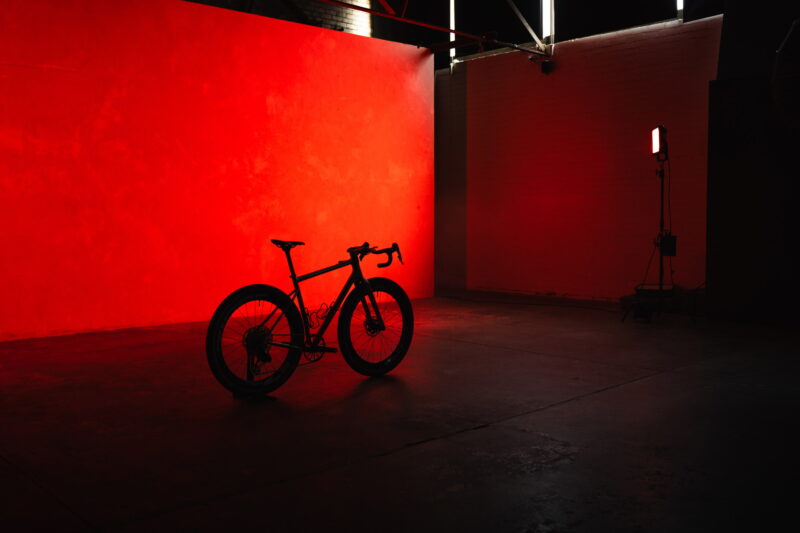
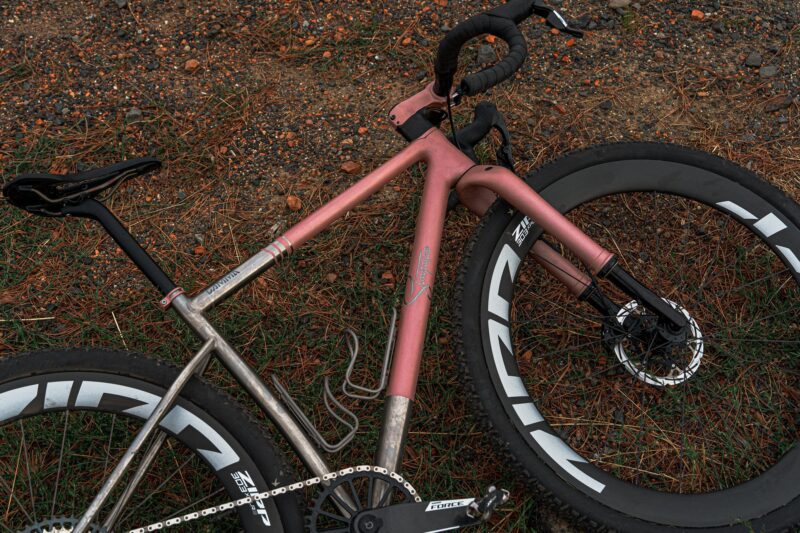
Aidan raced the same N1 he uses for ultras. “Same bike, pretty much the same across the board,” he says. For bikepacking he runs a suspension seatpost; for Worlds he put a carbon post back on. He fitted a bigger chainring for race speeds and swapped in a new wheelset. The tires stayed the same.
“It doesn’t need much to change, and it can do it all.”
Rain the day before took the edge off the pea gravel, turning most of the course into hero dirt. “I didn’t have one moment where I was like, ‘Oh, shit, I’m about to go down,'” he says. “The tires and it all just gripped up really well the whole time.” He puts that down to getting the combination of tire volume and pressure right.
Explainer: Hero dirt
Riders’ slang for ground that is damp enough to bind together but not wet enough to turn to mud. Tires bite into it and the dust stays down. On Nannup’s pea gravel, which rolls under a tire when it’s dry, one day of rain made that difference.
First impressions of the Nvisage AR65 wheels

The new wheels were Nvisage AR65s: 60 millimeters deep at the front and 65 at the rear, with a 32-millimeter internal width, hooked rims and straight-pull Sapim CX-Ray spokes.
His time on them was short. “I would have loved to have been able to do a lot more riding around the area and the lead-up to it,” he says. “I guess I only really rode them in anger for that two hours or so. But they felt really good.”
The course had fast sections and a light, changeable wind, and that was what he noticed most. “You get some deep-dish wheels and you’re really getting blown around in the crossies,” he says. “But these ones felt really well planted, super smooth.”
They are a little wider than his old wheels, though not by enough to feel like a night-and-day difference.
Asked whether he would take them into other kinds of riding, he sees no reason not to. As far as he can remember, they aren’t much heavier than his previous set. “They’ve still got exposed spoke nipples, so you can still service them on the road,” he says. “There’s no mechanical reason why I wouldn’t run them in an ultra.” He would ride them on the road as well, where he thinks they would pair well with a 35 mm tire.
His one reservation is the look. The AR65 graphics are much bolder than those on his old wheels, and he usually prefers something subtler. “I think a nice colored sticker patch to pair it in with the bike, I think that’d go off well,” he says. He knows not everyone agrees. “Some people definitely love the big bold on there. It can be a bit polarizing.”
What he takes from it
Asked what other riders could learn from his race, Aidan starts with the obvious one: “Don’t get sick before the race. That’s number one.”
“Fueling before the race is as important as fueling on the race day,” he says. “You take away that fuel beforehand, and there goes your race.”
He would like another shot at a world championship to see what he can do healthy. If it doesn’t come, he’s happy with what he gave this one. “I did what I could with the sickness. There’s nothing I could change that.”
For now, the plan is a doctor first. “Whatever cough I’ve got has embedded itself deep within my lungs,” he says. Then a summer without a big goal. The last two went to training for the 24-hour record, “which was a lot of indoor training, unfortunately.” This time he wants to be outside, riding a few small local events and spending more time on the road. Nothing big is on the calendar. “I’m not going to deny any if something pops up that takes my liking.”
At some point he would like to go back to the Tour Divide, to race it or just to ride it slowly enough to see everything.
“One day I’ll be back.”