
Tire clearance is the largest tire a frame and fork can take with enough room left over to ride safely. It decides which roads a gravel bike can handle, and it is one of the few things you can’t change after you buy. This guide covers what the clearance number really means, how much room to leave, and which tire widths suit which terrain.
What gravel bike tire clearance measures
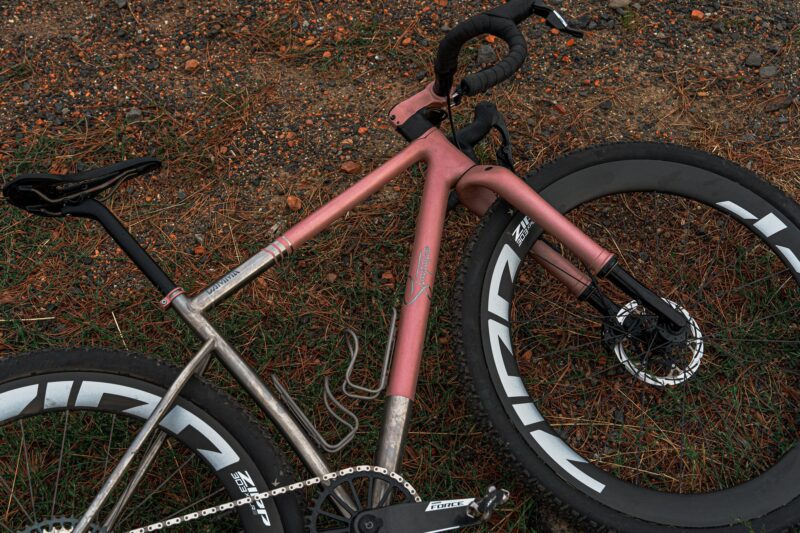
A frame’s clearance is limited by its tightest point. On most gravel bikes that is the chainstays behind the bottom bracket, the seatstays near the brake, the fork crown, or the front derailleur on a bike with two chainrings. A frame rated for a 50 mm tire has to clear it at all of those points.
Front and rear limits are often different. The fork may take a bigger tire than the rear triangle, or less if it is a suspension fork. The drivetrain matters too. A double chainring and front derailleur take up space next to the rear tire, so many frames take a narrower rear tire with a 2x setup than with 1x.
Why a 45 mm tire may not measure 45 mm
The width printed on the sidewall is measured on a particular rim. Mount the same tire on a wider rim and it spreads out and measures wider. It also grows a little as the casing stretches over the first few rides. Two tires with the same label can differ by a few millimeters, depending on the brand and the tread.
If you are close to a frame’s limit, check the tire on the rim width you will actually use. Our bike tire size guide explains how to read tire sizes. For example, our Nvisage G60 gravel wheels have a 38 mm internal rim width and are designed for 45 to 57 mm tires. A tire on that rim will usually measure wider than the same tire on a narrow road rim.
How much mud clearance to leave
The gap around the tire has to allow for more than the tire itself. Wheels flex slightly under load, mud and grass build up on the tread, and small stones get picked up. In dry conditions a few millimeters each side is usually enough. If you ride in sticky mud, leave more, or run a narrower tire than the frame’s maximum on wet days.
That is why a brand’s clearance figure should state the tire size with mud room, not the widest tire that physically squeezes in.
Gravel tire width by terrain
| Riding | Typical width |
|---|---|
| Mostly pavement with some smooth hardpack | 32 to 38 mm |
| Mixed gravel roads and pavement | 40 to 45 mm |
| Rough, loose or corrugated gravel | 45 to 50 mm |
| Technical terrain, bikepacking and loaded touring | 50 mm and up |
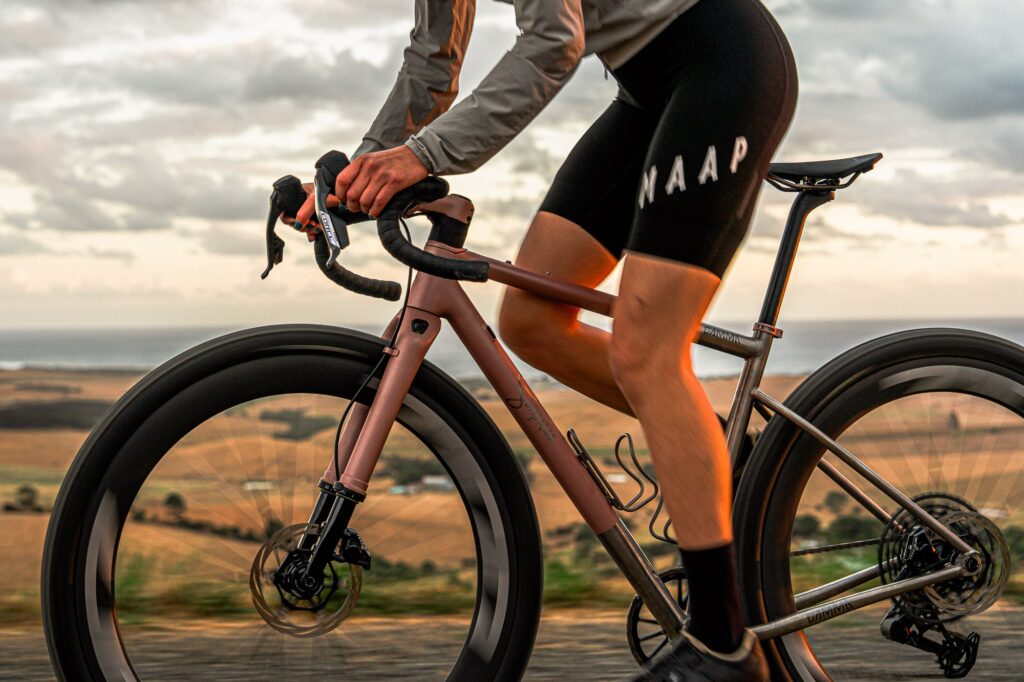
Treat these as a rough guide. Tread, casing and tire pressure matter as much as width. A supple 45 mm tire at the right pressure can feel faster on rough roads than a stiff 40 mm tire pumped up hard. More clearance gives you room to choose, and you can always fit a narrower tire to a frame with plenty of room.
Tire clearance on the Gamma Race, Gamma X and N1
| Model | Front | Rear | Notes |
|---|---|---|---|
| Gamma Race | 60 mm | 2.2 in (about 56 mm) in dry conditions | Designed around 45 to 60 mm tires for fast gravel |
| Gamma X | 50 mm | 2.2 in (about 56 mm) in dry conditions | Front limit is set by the Cane Creek Invert suspension fork |
| N1 | 45 mm with 2x, 48 mm with 1x | Also runs road tires from 28 mm, including 35 to 40 mm | |
On the Gamma frames, run a slightly narrower rear tire in mud; how much depends on your local soil and weather. The N1 is our all-road gravel bike: fast on 35 to 40 mm road tires, and a real gravel bike on hardpack and smoother dirt with 45 mm tires on 2x or 48 mm on 1x. If you want tires wider than 48 mm, or ride loose and rough gravel, the Gamma Race gives you room for the widest tires. Complete builds pair each frame with a rim sized for its tires: the G60, for 45 to 57 mm tires, on the Gamma Race and Gamma X, and the AR65, for 35 to 40 mm road tires, on the N1. To pair a wide tire with a fast rim, read our guide to carbon gravel wheels and our aero gravel setup guide. Our comparison of gravel bikes vs road bikes goes further into that choice.
Checklist: confirming a tire fits your frame
- Check whether the stated clearance includes mud room or is the maximum that fits.
- Check the front and rear limits separately.
- Check whether the limit changes with a 2x drivetrain.
- Check the tire on the rim width you will use.
Clearance is one of several things to check. Our guide to choosing a titanium gravel bike covers the rest.